top of page

A Celebration of "Two Horses" by Black Country, New Road

  • Writer: Anna Lux
    Anna Lux
  • 2 days ago
  • 8 min read

Anna Lux Petro


It has been roughly one year since Black Country, New Road released Forever Howlong, the band’s third studio album, this time starring the talents of their female singers and songwriters, Tyler Hyde, Georgia Ellery, and May Kershaw. The transition to this magical source of femme consciousness is apparent, as the album can be digested as a shrine to the twenty-first century female experience. Complete with archetypal tales of feminine development and individuation, the psychological depth of their collective storytelling should not be overlooked, especially as it is often delivered with a sense of lightness and irony (that duality itself a hallmark to the feminine experience). 
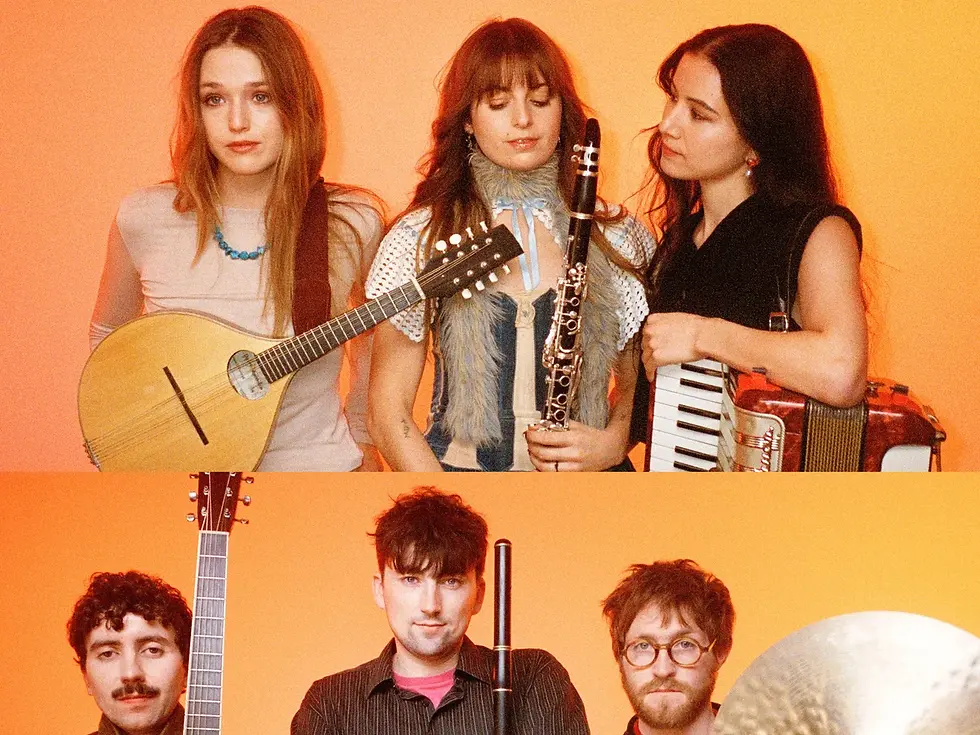

From left to right: Georgia Ellery, Tyler Hyde, May Kershaw, Luke Mark, Lewis Evans, Charlie Wayne (photograph: Eddie Whalen)

Today we are focusing on my favorite song of the album: “Two Horses,” written and performed by Georgia Ellery, who has described it as a “dark American frontier story.” In this post, we are going to go through the song’s lyrics and composition as a work of poetry, analyzing the archetypal plot and stylistic genius.


The song, which is the fifth track on an album of eleven, is introduced with eerie hums of mysterious female counterparts (Hyde and Kershaw). Ironically, Ellery quickly counters, “I’m a faraway traveller / I travel alone.” Although our protagonist believes she is by herself, we know she is truly accompanied by the spirit of every woman before, near, and after her. Her story is not singular; instead, it describes the psychic evolution of so many within the female collective. Like the narrator, we often decipher our journeys as isolated and unique, but are unknowingly enduring them with the help of our female ancestors and counterparts. 


Ellery immediately describes the initial intention of the traveller: 


“Searching in the mist / For what I know exists for me out there / Solitary awaits me out there / I know she will / She was there before the rain / Before these dunes / Before they made the pyramids” 


The protagonist seems to have a clear-headed approach to her journey, being oddly aware of the fact that her destination is ultimately one of being alone. She communicates this somewhat solemnly, but also from a place of wise knowing that it is not something she can change. Of course, she refers to solitude as a feminine entity, being intuitively aware that it is the fundamental element of the feminine, or yin, nature, and that Earth comes from nothing and will return to it. Likewise, we come from our mother’s womb as one, and in this way we will also depart. 


Ellery continues, “Oh, waited so long / Have I finally found the road to lead on?” We can decipher that the “waiting” she is referring to has to do with the primitive and monotonous task of development. Before we can start outward on our heart’s traverses as an independent entity, we must mature to this point: facing a mysterious road by ourselves, not knowing where it will take us. This happens some point after psychologically individuating from the people that raised us, which can occur at any age.


Then, our protagonist’s first conflict: 


“The moon was low and the road dusty / When I was captured by some thieves / My pockets empty / I said, ‘You’ll have to kill me to cut this jewel out of me’ / They let me go”


Set in early evening, presumably shortly after the sun goes down, the narrator is attempted to be robbed. She explains that she has no money and that her only value is that of her soul. Of course, the thieves have no interest in her petty soul and lack of monetary value, so they dispatch without further injury to our narrator. There’s a sense of comedic irony in this outcome, felt in the narrator’s release into wails that can primarily be deciphered as relief, but also somewhat of mourning. After all, the internal material of her being was just rejected. 


This confrontation is an important one within our evolution and can be represented by any formative environment that exploits the female for her value as a functional workhorse at the expense of her spirit; most notably, the capitalist workplace, competitive academia, or even the female’s family. Although it sounds like the protagonist’s reaction is a straightforward one, her sacrificial defense of her soul is a coming-of-age that requires significant development and self-respect. She is able to outwardly recognize that she has no value except for the inherent “jewel” of her own being, and if they take that, they might as well just kill her. Assuredly, the thieves (i.e., employers, meritocracy, parents, etc) don’t actually give a fuck about her soul, implicitly scoffing, “Go ahead and do what you want with that. We only care about what you can put in our pockets.” Thus, she continues onward, alone once more. 


For the first time since the introduction of the song, the female collective joins in with Ellery’s wails and hums along with her, nodding to us that they are still with her, secretly supporting her through her journey’s checkpoints. 


Next, the protagonist arrives at perhaps the primary challenge of the song’s storyline, in which she meets a male counterpart: 


“Stopped at the next bar for a neat drink / Across from where I sat a man gazed at me / He looked just like James Dean / On the silver screen / Our eyes did meet / And he winked / at me / Oh, is this the one?” 


As the narrator introduces this meeting, we nearly miss the significance of it; the melodic composition has not yet shifted from her earlier ventures. She describes an attractive man at the other end of the bar with whom she makes eye contact. Her tone only begins to change once she heartily professes, “he winked… at me.” A drink and mere wink in her direction is all it requires for the protagonist to launch into full-fledged conviction that she has met “the one.” This is perhaps my favorite line of the song; it’s a shamefully classic female experience executed in a manner that perfectly portrays the dissonance between its logical deficits and emotional severity. If you didn’t properly digest this song, you might miss the humor and sarcasm with which Ellery retells our painful follies. 


“Have I finally found a man to lean on? / Will you help me and my horses on my way / through night and day?”


As the protagonist begins to erroneously re-conceptualize her journey with this suitor at her side, the music parallels her transition into romantic psychosis, raising in intensity as she communicates her hope and excitement. Then, after a short beat, the composition completely transforms into its second section, increasing in tempo and shifting into a mood of tension. We are now very much in the rising action of this character’s story, inching toward the implicit climax of her fate. 


“Oh / I can see my destination on the line / And if the stars are aligned / Not gonna be a next time” 


In this line, the narrator seems to be referencing her initial destination of solitude. By asserting there’s “not gonna be a next time” if everything goes right, she may be implying that she hopes to escape the inevitable prospect of being alone. It may also be a hint to the audience that this process has actually happened before with another man, and she’s praying it turns out in her favor this time. She becomes so frenzied by the possibility of not having to continue alone that she enters into a state of simultaneous anxiety and euphoria: 


“I’ll check him while he’s sleeping / Can never trust a man who’s drinking whisky at the bar alone / But his arms are around your waist / And your hair is blowing in the wind / and it felt alright” 


Clearly, our protagonist knows—either from past experience or her own female intuition—that she must seriously examine the character and intentions of this man. But, as it occurs so often, she gets caught up in the sensual ecstasy of a male counterpart, and negates following through with her plan to do so. Ellery briefly shifts into a second-person point of view when relaying this trope, communing with both the female collective audience as well as her past self. She quickly reminisces, “and it felt alright,” increasing the intimacy of her recollection as she observes the memory in past-tense, almost with a sense of acceptance and forgiveness for what happens next. 


Black Country, New Road now launches into a beautiful instrumental marked by the anticipatory sorrow that radiates out of Ellery’s mandolin and Evans’ saxophone. Ellery pairs it with her own vocal laments, gasping remorsefully for what turns out to be naïveté-enabled loss.


“And on that second night he came for me / He took a knife out of his boot / And silently I learned the truth / He was a liar / A leech and a beggar / And through the embers / I watched him kill my horses


Ellery rightfully delivers the climax of the female’s fate with disbelief, anger, and a sense of humbled detachment. She reveals the character of the man she made love with to be “a liar, a leech and a beggar.” Then, she quietly witnesses the disgusting reality of her fate: he kills her horses. 


The female’s two horses, who are mentioned once before this point and whom the song is named after, are symbolic of her life force. Throughout mythology, a female’s horses are representative of her connection to the external world; the horses transport the sacred feminine throughout her journey on earth, protecting and delivering her wherever she is called next. The “horses” are where the feminine metaphorically funnels her aforementioned soul, giving them care and love so they may serve her healthily and with integrity. Without her horses, the woman’s soul is rendered obsolete and she is unable to heartily continue on her journey.


At first, the audience may be confused or even relieved that the man only kills her horses. After all, he had a knife, and for a moment we expected for him to murder her. However, the man is not a bloodthirsty nut, and he did not desire to kill the narrator. His decision to quietly kill her horses and depart is characterized by a lower threshold of misogyny that is prevalent within Western society. 


During his exit, the man had many options: saying goodbye; leaving quietly, without harm; or, even more sensibly, stealing one or both of her horses for himself. The malevolence of silently killing both horses of a woman he does not know can only be done out of a deep-rooted hatred for women. Ellery’s writing is implicative of a society in which unassuming females are exploited sexually and then robbed of their life force by romantic hopes of a masculine savior. This feeble hope has paralyzed generations of the female spirit, and requires rude awakenings like this one into the brute reality that the male race often prefers the defenseless submission of the feminine life force. 


Perhaps the worst element of this betrayal is that it is largely felt as a betrayal of self; the protagonist initially knew that she shouldn’t have trusted the man, but she ignored her intuition and actively participated in her own demise. In the severe instrumental following the event, the female collective is heard wailing for the third and final time, representing the grief of the now withdrawn protagonist. Then, the music abruptly stops, except for Ellery and her mandolin: 


“River, river take me / Down to the waterfall / Won’t come back at all / Just let me fall”


In the final moments of the song, we experience the protagonist’s depressed resignation and familiar sense of self-surrendering. Fatefully, she has once again returned to her initial path: that of solitude, resilience, and self-discovery. 


Black Country, New Road then effortlessly transitions into Hyde’s “Mary,” a solemn ballad of a (perhaps the same) disempowered female suffering the mundanity of living. The artists’ artful storytelling continues throughout the remainder of the record, hauntingly conveying the complex wilderness of the feminine psyche. Go give it a listen.


"Two Horses" official lyric video: https://youtu.be/CsPNSBATvbE?si=TZ5f9EhL7G4lCOK8


xx Anna Lux 

© 2025 by Anna Lux.

bottom of page